


Reaching the right decision-maker often feels like searching for a needle in a haystack. As European sales teams push for growth, the accuracy of contact data can spell the difference between a productive campaign and a string of bounced emails. Verified data, maintained through rigorous screening and validation, is trusted to deliver authentic connections and reduce costly outreach errors. This article breaks down what sets truly reliable B2B data apart, guiding you to better conversion and sustained sales performance.
Table of Contents
- What Makes B2B Data Verified And Reliable
- Comparing Data Types: Verified Versus Unverified
- How Verified Data Powers Outbound Sales
- Compliance And Privacy In B2B Data Usage
- Risks Of Using Unverified Company Data
Key Takeaways
| Point | Details |
|---|---|
| The Importance of Verified Data | Verified B2B data ensures high accuracy, significantly enhancing sales effectiveness and outreach strategies. |
| Risks of Unverified Data | Unverified data can lead to wasted resources, compliance violations, and damage to reputation. |
| Ongoing Data Maintenance | Regular updates and validation processes are crucial for maintaining data integrity and relevance. |
| Compliance and Trust | Adhering to data privacy regulations builds trust and improves client relationships, enhancing competitive advantage. |
What Makes B2B Data Verified and Reliable
Ensuring the reliability of B2B data requires a comprehensive approach that goes beyond basic contact information. Verified data represents a rigorous validation process that transforms raw contact lists into actionable sales intelligence. This verification involves multiple layers of authentication and continuous quality checks.
The core components of verified B2B data include:
- Identity Validation: Confirming the actual existence of the contact through multiple independent sources
- Role Confirmation: Verifying the professional’s current job title and department
- Contact Accuracy: Ensuring email addresses, phone numbers, and professional contact details are current and functional
- Company Verification: Validating the organization’s details, including size, industry, and operational status
High-quality B2B data verification involves sophisticated screening methods that go well beyond simple self-reported information. Professional data providers use advanced techniques like cross-referencing multiple databases, conducting periodic validation checks, and employing machine learning algorithms to maintain data integrity.
Reliable B2B data also requires ongoing maintenance. This means regularly updating contact information, removing outdated records, and continuously monitoring data quality. Companies invest significant resources in maintaining the accuracy of their contact databases, understanding that stale or incorrect information can dramatically reduce sales effectiveness.
Pro tip: Implement a quarterly data validation process to ensure your B2B contact lists remain accurate and actionable.
Comparing Data Types: Verified Versus Unverified
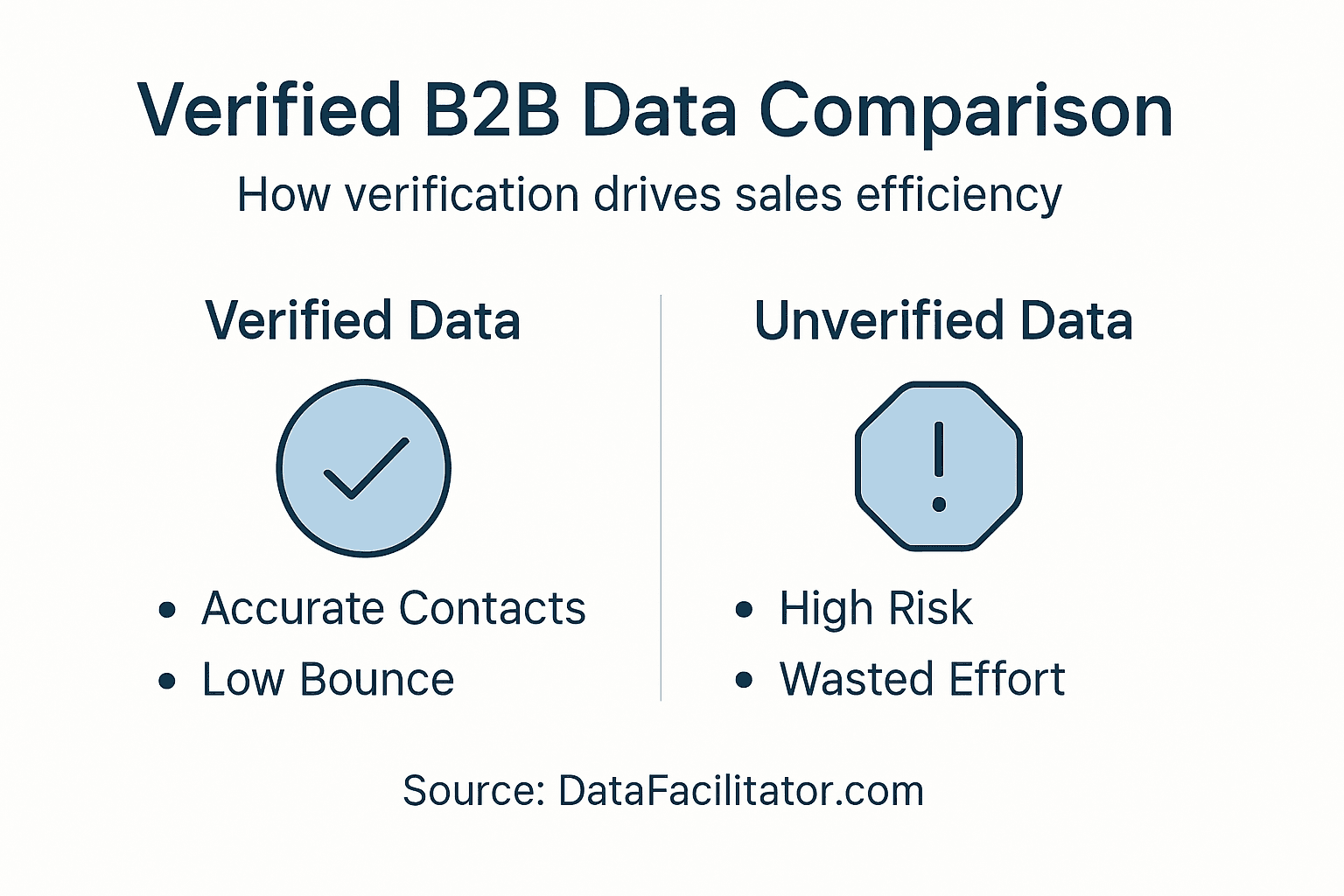
Understanding the critical differences between verified and unverified B2B data can dramatically impact sales performance and marketing strategy. Unverified data often represents a collection of potentially outdated, inaccurate, or randomly scraped contact information that lacks rigorous validation processes. In contrast, verified data undergoes comprehensive authentication to ensure reliability and actionable insights.
The key distinctions between verified and unverified data include:
- Source Quality: Unverified data frequently comes from automated web scraping or user-generated submissions, while verified data relies on professional research and validation
- Accuracy Rate: Unverified sources typically have error rates between 30-60%, compared to verified data with accuracy rates exceeding 90%
- Update Frequency: Unverified data might remain unchanged for years, whereas verified data receives regular updates and continuous validation
- Compliance Standards: Unverified data often fails to meet legal and regulatory requirements, risking potential legal complications
Scraped versus research-grade data demonstrates stark differences in data collection methodology. Automated tools collecting unverified information cannot match the precision of human-verified research processes that include direct contact confirmation, cross-referencing multiple sources, and rigorous validation protocols.
The impact of data quality extends beyond simple contact information. Unverified data can lead to wasted sales efforts, decreased conversion rates, and potential damage to a company’s reputation. Professional sales teams recognize that investing in high-quality, verified data provides a significant competitive advantage, enabling more targeted and effective outreach strategies.
Here’s how verified and unverified B2B data impact business outcomes:
| Impact Area | Verified Data Benefit | Unverified Data Risk |
|---|---|---|
| Sales Efficiency | Increases productivity | Leads to wasted resources |
| Reputation | Builds client trust | Damages brand credibility |
| Legal Compliance | Reduces violation risk | Increases exposure to lawsuits |
| Market Insights | Enables accurate targeting | Causes misaligned strategies |
Pro tip: Conduct a sample audit of your current data sources to assess the percentage of verified versus unverified contacts in your database.
How Verified Data Powers Outbound Sales
Verified B2B data transforms outbound sales strategies from hit-or-miss approaches to precision-targeted campaigns that dramatically improve conversion rates. By providing accurate, up-to-date contact information and detailed insights about potential clients, verified data enables sales teams to craft more intelligent, personalized outreach strategies that significantly enhance their engagement potential.
The key advantages of leveraging verified data in outbound sales include:
- Precise Targeting: Eliminating wasted efforts on incorrect or outdated contact information
- Higher Conversion Rates: Connecting directly with decision-makers in relevant roles
- Reduced Bounce Rates: Ensuring email deliverability and communication effectiveness
- Enhanced Sales Productivity: Allowing representatives to focus on quality interactions
- Compliance Assurance: Maintaining legal and regulatory standards in contact management
Data-driven outbound sales strategies leverage verified information to map buying groups and identify critical buying signals. This approach transforms traditional cold outreach into a more strategic, intelligence-backed process that aligns sales efforts with actual customer needs and potential purchase readiness.

Professional sales organizations recognize that verified data is not just a luxury but a necessity in today’s competitive market. By investing in high-quality, continuously updated contact databases, companies can reduce wasted resources, improve team efficiency, and create more meaningful connections with potential clients. The precision of verified data allows sales teams to craft personalized messages that resonate with specific decision-makers, increasing the likelihood of meaningful engagement.
Pro tip: Implement a monthly data hygiene process to validate and refresh your contact database, ensuring ongoing accuracy and relevance.
Compliance and Privacy in B2B Data Usage
Navigating the complex landscape of B2B data privacy requires a comprehensive understanding of global regulatory frameworks and ethical data management practices. Sales and marketing professionals must recognize that data compliance is not just a legal requirement, but a critical component of building trust with potential clients and protecting organizational reputation.
Key compliance considerations for B2B data usage include:
- Consent Management: Ensuring explicit permission for data collection and usage
- Data Minimization: Collecting only necessary information for specific business purposes
- Storage Limitations: Implementing secure data retention and deletion protocols
- Cross-Border Data Transfer: Understanding international regulatory variations
- Transparent Data Practices: Maintaining clear communication about data usage
Global privacy regulations impact B2B data strategies by imposing strict requirements on how organizations collect, process, and manage contact information. Companies must develop robust compliance frameworks that adapt to evolving legal landscapes across different jurisdictions, balancing innovative marketing approaches with rigorous privacy protections.
The most sophisticated B2B organizations view data compliance as a competitive advantage rather than a mere regulatory burden. By implementing comprehensive privacy protocols, companies can differentiate themselves as trustworthy partners who prioritize data security and individual rights. This approach not only mitigates legal risks but also builds stronger, more transparent relationships with potential clients who increasingly value data protection.
Use this reference table to understand best practices for B2B data compliance:
| Compliance Factor | Business Advantage | Implementation Suggestion |
|---|---|---|
| Consent Management | Strengthens customer trust | Use clear opt-in forms |
| Secure Data Storage | Protects client information | Employ encrypted cloud solutions |
| Regular Audits | Maintains regulatory readiness | Schedule quarterly reviews |
Pro tip: Conduct a quarterly audit of your data collection and management processes to ensure ongoing compliance with the latest international privacy regulations.
Risks of Using Unverified Company Data
Unverified company data represents a significant threat to sales performance, potentially undermining entire outreach strategies with inaccurate, outdated, or misleading contact information. Unvalidated data sources can create substantial operational risks that extend far beyond simple communication inefficiencies, potentially exposing organizations to legal, financial, and reputational challenges.
The primary risks associated with unverified company data include:
- High Bounce Rates: Email addresses and contact information that lead to dead ends
- Compliance Violations: Potential breaches of data protection regulations
- Resource Waste: Sales teams spending time on invalid or incorrect leads
- Damaged Reputation: Persistent communication attempts to incorrect contacts
- Inaccurate Market Intelligence: Skewed understanding of target market segments
With several internal resources available, sales teams can mitigate data quality risks by implementing rigorous validation protocols. Unverified data introduces unpredictable variables that can derail carefully constructed sales pipelines, transforming potentially promising opportunities into costly distractions.
Professional sales organizations understand that the cost of using unverified data far exceeds the investment required to secure accurate, validated contact information. Poor data quality can lead to significant downstream consequences, including wasted marketing budgets, decreased sales team morale, and missed revenue opportunities. By treating data verification as a critical strategic priority, companies can protect their sales ecosystem from potentially catastrophic information failures.
Pro tip: Implement a strict data validation protocol that requires multiple verification touchpoints before adding any contact to your sales database.
Unlock Sales Success with Verified B2B Data from DataFacilitator
Struggling with outdated or inaccurate contacts can stall your outbound sales and damage your team’s productivity. This article highlights the critical importance of using verified B2B data to reduce bounce rates, improve conversion, and maintain compliance. If your goal is precise targeting and meaningful engagement with decision-makers, you need a solution that delivers trustworthy, up-to-date company data tailored to your market.
At DataFacilitator.com, we specialize in providing scalable and compliant verified B2B contact lists that empower your cold outreach and market analysis efforts. Our transparent validation process ensures each lead is real and current, so you pay only for actual, actionable contacts. Explore our flexible options that cover specific industries, countries, and niches with comprehensive company insights including emails, phone numbers, and social profiles.
Ready to elevate your sales with data you can trust Right Now Explore our collection of verified leads and start closing deals faster We handle the leads, you close the deals. – DataFacilitator
Don’t let unverified data hold you back Act now by visiting DataFacilitator to access high-quality B2B leads or learn more through our frontpage collections We handle the leads, you close the deals. – DataFacilitator. Experience how accurate data can transform your outbound sales strategy and deliver measurable growth today.
Frequently Asked Questions
What is verified B2B data?
Verified B2B data refers to contact information that has undergone a thorough validation process, ensuring its accuracy and reliability through multiple layers of authentication and continuous quality checks.
How does verified data impact sales efficiency?
Verified data significantly increases sales efficiency by providing accurate contact details, reducing wasted efforts on incorrect information, and allowing sales teams to connect directly with decision-makers.
Why is unverified data risky for businesses?
Unverified data poses several risks, including high bounce rates, compliance violations, wasted resources due to incorrect leads, and potential damage to a company’s reputation through persistent outreach to wrong contacts.
What are best practices for maintaining verified B2B data?
Best practices include implementing a regular data validation process, conducting quarterly audits, ensuring compliance with privacy regulations, and continuously updating contact information to maintain accuracy.