


Sorting through a list of thousands of Dutch business contacts can feel overwhelming when every company operates differently. For B2B tech firms in the Netherlands, generic outreach falls flat because decision-making is complex, with buying centers made up of several stakeholders. B2B list segmentation identifies the right target buyers amidst complex products and rational purchasing processes, enabling you to tailor your outbound sales for higher precision and better returns. This article shows how targeted segmentation helps your campaigns connect with real prospects who actually respond.
Table of Contents
- What Is B2B List Segmentation And Why It Matters
- Types Of Segmentation For B2B Contact Lists
- How Segmentation Improves Outbound Sales Results
- Legal Compliance And Data Privacy In Segmentation
- Common Mistakes To Avoid When Segmenting Lists
Key Takeaways
| Point | Details |
|---|---|
| B2B List Segmentation Is Essential | Dividing prospective customers based on shared characteristics enables more effective targeting and personalized messaging, leading to higher response rates. |
| Understand Buyer Roles | Recognizing the different roles within buying centers allows for tailored communication strategies that resonate with each decision-maker’s specific concerns. |
| Prioritize High-Value Segments | Concentrating efforts on segments with the highest potential value ensures better resource allocation and faster sales cycles, optimizing overall performance. |
| Compliance Is Crucial | Adhering to data privacy laws, like GDPR, is essential when segmenting lists to avoid legal risks and build trust with prospects. |
What Is B2B List Segmentation and Why It Matters
B2B list segmentation means dividing your prospective customers into smaller, more specific groups based on shared characteristics. Instead of treating all companies on your outreach list the same way, you organize them by industry, company size, location, buying stage, or other relevant factors. This isn’t arbitrary categorization. You’re creating meaningful buckets that reflect how different types of companies make purchasing decisions and what problems they actually need solved.
Why does this matter for your outbound sales efforts? B2B buying is fundamentally different from consumer purchasing. When you reach out to a prospect, you’re not selling to one person making an impulse decision. You’re navigating complex buying centers with multiple stakeholders, each with different priorities and concerns. A technical director cares about integration capabilities. A finance manager cares about ROI and implementation costs. A procurement specialist cares about vendor terms and compliance. Segmentation lets you acknowledge these different roles exist within your targets and craft messages that actually resonate with each decision-maker’s specific angle.
Consider a practical scenario. You’ve purchased a list of 5,000 Dutch tech companies. Without segmentation, you might send the same email to a 20 person SaaS startup and a 500 person manufacturing firm. The startup’s founder might wear five hats and make purchasing decisions quickly. The manufacturing firm has formal approval processes, budget cycles, and regulatory requirements. Your generic message misses both audiences. But if you segment by company size, industry vertical, and revenue stage, you can customize your approach. Your outreach to early stage software companies emphasizes speed and flexibility. Your outreach to established industrial firms emphasizes compliance, integration, and proven ROI. Suddenly your response rates climb because your message actually matches their reality.
Segmentation also forces you to think clearly about resource allocation. Not every prospect on your list deserves the same effort level. You should identify which segments have the highest potential value, shortest sales cycles, or best product fit. Then concentrate your personalized outreach, your most experienced sales reps, and your higher quality data validation toward those high-potential segments. Segments with lower priority still get reached out to, but perhaps through more scaled, automated approaches. This isn’t being lazy. This is being strategic with limited time and resources. When you understand segmentation helps identify the right target buyers amidst complex products/02%3A_Understanding_the_Marketplace/05%3A_Market_Segmentation_Targeting_and_Positioning/5.02%3A__Segmentation_of_B2B_Markets), you’re essentially reverse engineering where to focus your energy for maximum impact.
Here’s what effective segmentation delivers for your sales team. First, higher response rates because your messaging speaks to actual business problems. Second, faster sales cycles because you’re reaching the right decision-makers with relevant information at the right time. Third, better data quality because you can validate and update segments that matter most to your revenue goals. Fourth, clearer performance metrics because you can track success by segment and understand which market types drive your best outcomes. And yes, I learned this the hard way by blasting generic messages to mixed audiences and watching response rates stay flat until we got serious about who we were actually trying to sell to.
Pro tip: Start by segmenting your list by just two or three variables that directly impact how your product fits their needs, like company size and industry, before you get lost in overly complex segmentation schemes that take months to implement.
Types of Segmentation for B2B Contact Lists
When you start segmenting your B2B contact list, you quickly realize there are multiple ways to slice the data. Different segmentation types serve different strategic purposes, and using the right combination makes your outbound efforts significantly more effective. The key is understanding which segmentation dimensions matter most for your specific sales goals and then building your campaign strategy around those dimensions.
The most straightforward approach is firmographic segmentation, which divides prospects based on company characteristics. This includes industry, company size, geography, and other structural company attributes. You might segment software companies separately from manufacturing firms. You might divide by employee count, separating small teams under 50 people from mid-market companies with 50 to 500 employees from enterprise firms with thousands of workers. Geographic segmentation lets you focus on specific countries or regions, which matters tremendously for Dutch sales teams operating across Europe or targeting the Benelux region specifically. You can also segment by annual revenue, funding stage (for startups), or years in business. Firmographic data is stable, relatively easy to capture in your database, and directly influences how companies buy. A bootstrapped startup operates completely differently from a well funded venture capital backed firm, even within the same industry.

Beyond company characteristics, behavioral segmentation reveals how companies actually purchase. This includes their buying habits, decision-making processes, and purchase history. Have they bought from competitors before? Are they actively searching for solutions or still in research mode? How long is their typical sales cycle? What channels do they prefer for business communication? Understanding buying center dynamics with decision-makers, influencers, and users becomes crucial because you need to know who actually drives purchasing decisions at each type of company. In some organizations, the CTO makes the call. In others, the CFO controls budget approval. In larger firms, you might need buy-in from multiple stakeholders. When you map these behavioral patterns, you can craft outreach strategies that acknowledge these realities. High engagement prospects with active buying signals deserve immediate, personalized follow up. Prospects still in early research mode might receive longer-form educational content instead of aggressive sales pitches.
There’s also intent based segmentation, which identifies companies showing clear signals they’re ready to buy. These signals might include recent job postings in relevant departments, company news about expansion or investment, website visits to your content, or engagement with your industry publications. Companies actively hiring software developers probably need development tools. Companies announcing office expansions likely need facilities management solutions. Companies launching new product lines might need supply chain optimization. This segment typically has the highest conversion potential because they’re already motivated by business needs. Spend your best sales resources here.
Finally, value based segmentation organizes prospects by their potential revenue or profitability to your business. Some companies might be smaller but extremely profitable for you due to high margin products or long contract values. Others might be large but lower margin. Some segments might be stepping stones to bigger opportunities. Value based thinking forces you to ask hard questions: Which segments drive our best unit economics? Which have the fastest sales cycles? Which have the highest customer lifetime value? This prevents you from chasing every opportunity equally and helps you allocate limited sales resources strategically toward segments that actually move your revenue needle.
The practical reality is that you’ll likely use a combination of these segmentation types simultaneously. You might layer firmographic, behavioral, and value based segmentation together to create highly focused prospect clusters. For example, you might target mid-market software companies in Germany that recently received funding rounds and are actively hiring engineers, with an estimated annual contract value above certain thresholds. This specificity feels restrictive at first, but it dramatically improves your conversion rates because you’re reaching the exact right company at the exact right time with the exact right message.
Here’s how the main B2B segmentation types compare in practical use:
| Segmentation Type | Key Focus | Best Used For | Typical Data Needed |
|---|---|---|---|
| Firmographic | Company characteristics | Initial list targeting | Industry, size, location, revenue |
| Behavioral | Buying actions and processes | Tailoring outreach content | Purchase history, engagement levels |
| Intent-Based | Readiness signals for purchase | Prioritizing hot leads | Job postings, recent company news |
| Value-Based | Revenue or profitability impact | Optimizing sales investment | Historical sales data, profit margin |
Pro tip: Start with firmographic segmentation by industry and company size, then layer in behavioral signals like recent hiring or funding events to create focused segments that give you the highest quality outreach targets.
How Segmentation Improves Outbound Sales Results
Segmentation transforms outbound sales from a spray and pray exercise into a precision operation. When you stop treating all prospects as interchangeable and instead focus on distinct groups with aligned needs, your conversion rates climb, your sales cycle compresses, and your team stops wasting time on misaligned opportunities. The impact shows up immediately in your metrics. Response rates increase because your message actually speaks to what prospects care about. Close rates improve because you’re reaching decision-makers with relevant solutions at the right time. Cost per acquisition drops because you’re not throwing budget at unqualified or poorly timed prospects.
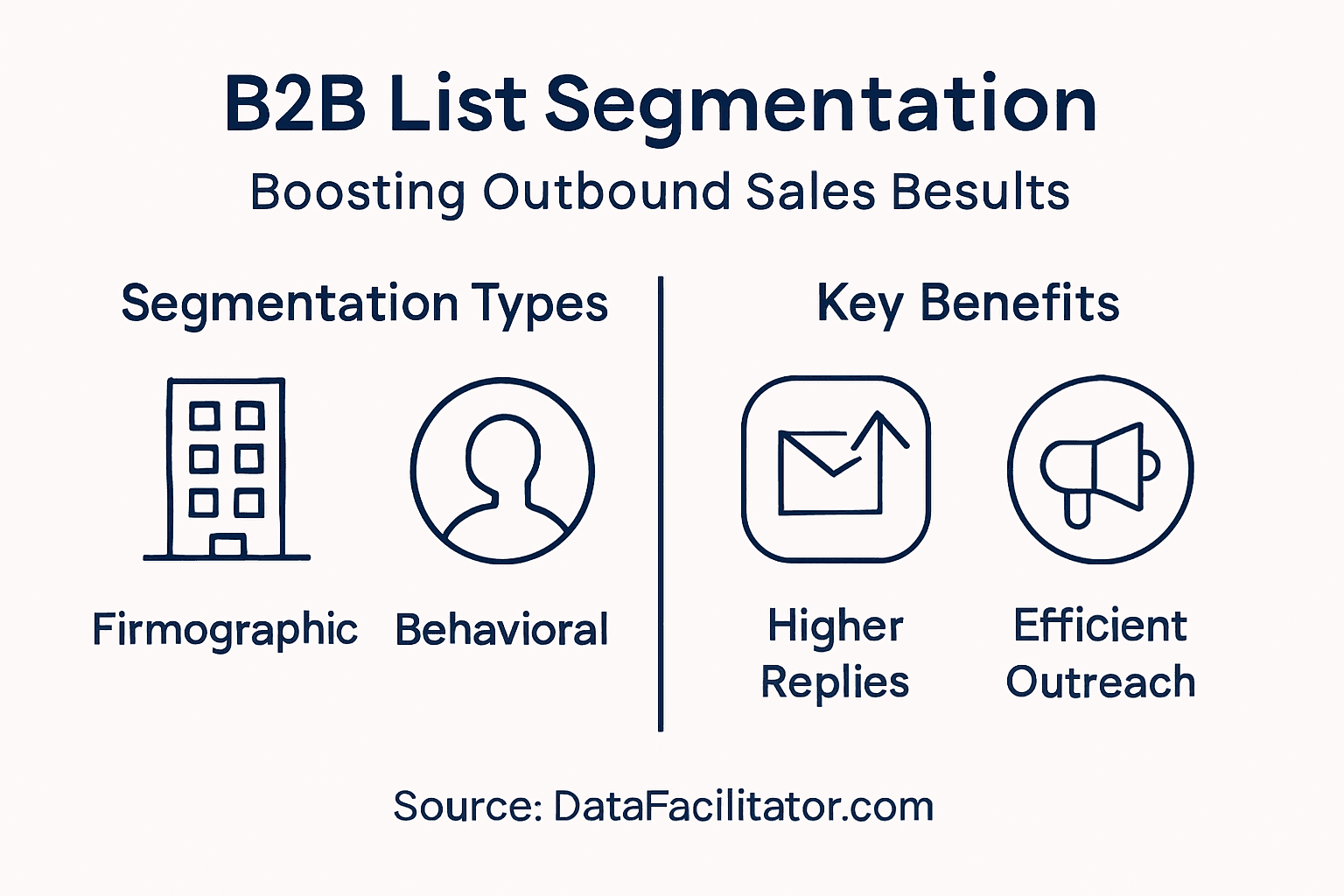
The core mechanism is straightforward. When you segment, you reduce wasted outreach and improve targeting precision. Instead of sending the same generic pitch to 5,000 companies, you send highly relevant messages to 500 companies most likely to buy. You might spend the same marketing budget or less, but you concentrate it where it actually converts. This is what tailoring messages to segmented groups accomplishes at scale. You minimize wasted resources and maximize the return on your outbound investment. A tech sales rep in Amsterdam cold calling manufacturing companies with a SaaS tool designed for software development teams is wasting everyone’s time. But that same rep calling software companies actively hiring engineers and already using development tools? That conversation has real potential. Segmentation ensures you’re making the second call, not the first.
Beyond immediate conversion metrics, segmentation enables personalized marketing strategies that fit customer needs and buying behaviors, which increases responsiveness across the board. Think about your own experience. You respond faster to emails that address your actual problems. You engage more with sales conversations that acknowledge your specific constraints and opportunities. Your prospects behave exactly the same way. When a sales rep reaches out mentioning your recent funding round and specific hiring patterns, you notice. When they reference your industry challenges and how similar companies solved them, you listen. When they propose a solution timeline that matches your fiscal quarter, you take the meeting. Segmentation makes this personalization possible at scale because you’re not trying to customize every single email to every single prospect. Instead, you’re creating 5 to 10 highly relevant messaging tracks, each designed for a specific prospect segment. Each track feels personalized because it actually is relevant to that specific group.
The efficiency gains compound over time. Generic outreach suffers from low conversion rates, which means your sales team spends enormous energy just getting meetings. Segmented outreach generates higher conversion rates per touch, which means your team closes more deals with less friction. This frees up capacity for relationship building and moving deals through your pipeline faster. Your best salespeople can focus on optimizing outbound sales outcomes by nurturing the most promising segments rather than qualifying unaligned leads. Your average salespeople can manage higher volumes because they’re working with warm, qualified prospects instead of cold contacts with low fit. Your marketing team can measure what actually works because you’re testing different messaging and tactics segment by segment, not blending all results together into unusable aggregate data.
Consider the practical impact. A Dutch software company targeting European B2B clients without segmentation might see response rates around 2 to 3 percent on cold outreach. After implementing basic segmentation by company size, industry, and buying stage, response rates often climb to 5 to 8 percent. Add behavioral signals like recent funding or hiring, and you might hit 10 to 15 percent. That’s not a marginal improvement. That’s the difference between a struggling pipeline and a thriving one. With the same sales team and same budget, you’re generating 3 to 5 times more qualified meetings. You’re moving from quantity based outreach to quality based outreach, and the sales results follow.
Pro tip: Track your response rates and conversion rates by segment separately, not as an aggregate, so you can identify which segments are actually worth your time and which need repositioning or different messaging.
Legal Compliance and Data Privacy in Segmentation
When you segment your B2B contact lists, you’re working with sensitive business data that exists within a complex web of legal requirements. The European Union’s GDPR, industry-specific regulations, and emerging data privacy laws across multiple jurisdictions all affect how you can collect, store, and use prospect information. For Dutch and European sales teams especially, this isn’t a minor compliance checkbox. It’s a fundamental requirement that shapes your entire segmentation strategy. Get it wrong and you face regulatory fines, reputation damage, and loss of customer trust. Get it right and you build a sustainable competitive advantage because your prospects know their data is handled responsibly.
Understanding the Legal Foundation
The core principle underlying modern data privacy law is simple but consequential: personal data must be processed lawfully, transparently, and for legitimate purposes only. Data privacy frameworks require organizations to adhere to rules that ensure transparency, consumer consent, and data minimization when processing personal information. For segmentation specifically, this means you can’t collect company data and then use it however you want. You must have a clear, documented purpose for collection. You must inform prospects about how their data is used. You must limit your use of data to that stated purpose. When you segment, you’re essentially categorizing people based on their characteristics and behaviors. That categorization itself can involve sensitive inferences about business decisions, financial situation, or growth trajectory. The regulation asks: Did these prospects consent to this type of analysis? Do they understand what you’re doing with their information?
The practical reality is that data privacy laws establish rules for lawful, transparent, and minimal data processing. You can’t hold more data than you actually need. You can’t retain it longer than necessary. You can’t share it with third parties without explicit permission. Each of these constraints affects your segmentation approach. If you’re building a segment of companies in financial distress based on payment delays, hiring freezes, and other signals, you’re making inferences that might violate data minimization principles. If you’re segmenting based on data purchased from a broker without explicit consent from the original data subjects, you’re creating compliance risk. If your segmentation criteria include protected characteristics or could enable discrimination, you’re moving into dangerous legal territory.
Practical Compliance Steps for Segmentation
Start by documenting your segmentation purpose. What business problem are you solving? What segments are you creating and why? Having clear documentation protects you because it shows regulators that your data use is intentional and justified, not arbitrary. Second, audit your data sources. Where did you get the information you’re using to segment? Was it provided directly by prospects? Purchased from a verified third party? Inferred from public company information? Different sources have different compliance implications. Data you collected directly typically requires explicit consent for segmentation use. Data from verified B2B providers like quality data sources specifically designed for outbound sales often comes with appropriate licensing that permits segmentation. Third, implement data minimization in practice. Only collect and segment using information directly relevant to your sales purpose. If you don’t need someone’s email contact frequency to make outreach decisions, don’t collect it. If hiring data from a specific department isn’t part of your targeting criteria, exclude it.
Third, build consent and transparency into your processes. When you’re adding new segments or changing how you use prospect data, consider whether additional consent is required. Create clear privacy notices that explain what you’re doing. Make it easy for prospects to access their data, understand how you’re segmenting them, and opt out if they choose. For European prospects especially, GDPR right of access requirements mean you must be able to explain your segmentation logic to any individual who requests it. Vague or opaque segmentation criteria create liability. Clear, documentable criteria reduce it.
Lastly, stay updated on regulatory changes. Privacy laws are evolving rapidly. New regulations emerge regularly in different jurisdictions. What was compliant last year might require adjustment this year. The cost of staying current is far lower than the cost of operating out of compliance. Companies specializing in B2B data for outbound sales, like quality data providers operating in the Netherlands and Europe, typically build compliance into their data handling and licensing terms specifically because they understand this landscape.
Pro tip: Document your segmentation criteria in writing before you execute any campaign, including what data you’re using, why you’re using it, how you got it, and how long you’ll retain it. This documentation becomes invaluable evidence of good faith compliance if regulators ever inquire.
Common Mistakes to Avoid When Segmenting Lists
Segmentation sounds straightforward until you actually start doing it. Then you realize there are countless ways to get it wrong. You can create segments that look good on a spreadsheet but fall apart when you try to reach those prospects. You can divide your list so finely that you end up with 50 micro-segments, each with only 10 people, making targeted outreach impossible. You can focus on data that feels important but doesn’t actually predict who will buy from you. The teams that succeed with segmentation learn these lessons quickly, either through their own mistakes or by watching others crash. Here are the most common pitfalls and how to avoid them.
Over-Segmentation and Resource Fragmentation
The biggest mistake most teams make is creating too many segments. It feels productive. You’re being specific. You’re being thorough. But then you realize you’ve created 30 different segments, each requiring custom messaging, each needing monitoring and optimization, each demanding sales team attention. Over-segmentation dilutes focus and resources, leaving you unable to execute well on any of them. Your sales team gets overwhelmed. Your marketing messages become generic again because you don’t have bandwidth to customize 30 different tracks. Your data becomes stale because you can’t keep all those segments updated. Start with three to five core segments aligned with your actual sales capacity. You can always add more later once you’ve proven you can execute well on the fundamentals. A Dutch software company with five sales reps should focus on five to seven segments maximum. A company with 30 reps might handle 15 to 20. Think operationally, not theoretically.
Collecting Data Without Actionability
Another common trap is accumulating massive amounts of data and then trying to segment based on everything you have. You’ve purchased a dataset with 50 fields per company. You think, why not use all of it? The problem is that creating overly complex segments makes them difficult to target effectively. You end up with criteria like companies in the software industry with 50 to 200 employees in Germany that received funding between 18 and 24 months ago and have specific technology keywords on their website and updated their LinkedIn profile in the last 90 days. That’s so specific you might have 5 companies in the entire world matching all criteria. More fundamentally, you’re creating segments based on data availability, not based on what actually matters for your sales. The question you should ask first is: What are the two or three things that genuinely predict whether this prospect will buy from us? Build your segments around those factors. If hiring growth predicts purchase likelihood, segment by it. If geographic location matters, segment by it. If industry vertical matters, segment by it. Leave everything else out of your segmentation logic, even if you have it in your database.
Failing to Consider Practical Reachability
You’ve created the perfect segment. Companies meeting very specific criteria aligned with your ideal customer profile. Then you discover you can’t actually reach these people. Your contact list is missing email addresses for this segment. Your phone data is out of date. You can’t find decision-makers. Proper segmentation requires segments that are clearly differentiated, actionable, and reachable aligned with your business capabilities. Before you finalize a segment, ask: Can we actually contact these people? Do we have good email data? Do we know who the decision-makers are? Can we find them on LinkedIn? If you can’t reach 80 percent or more of a segment, that segment isn’t viable no matter how perfectly defined it is. Reachability is a hard constraint, not a soft preference. When evaluating your segments, always verify that your contact data quality is sufficient for that specific segment before you commit resources to campaigning toward it.
Ignoring Buyer Motivations Behind Segments
You can also segment based on company characteristics while completely missing why those companies actually make purchasing decisions. You’ve segmented by company size and industry, which is a good start. But you haven’t thought about what problem each segment is trying to solve, what their buying timeline looks like, or what concerns keep them awake at night. Two software companies in the same industry with the same employee count might be in completely different buying situations. One is scaling rapidly and needs solutions that support growth at speed. One is optimizing operations and needs solutions that reduce cost. Same segment on paper. Completely different motivations underneath. Meaningful segmentation requires understanding underlying customer motivations behind purchases. After you define your segments, spend time understanding the actual business motivations within each one. Talk to customers in that segment. Ask your sales team what conversations actually happen with companies in that segment. Understanding these motivations lets you craft messaging that actually resonates instead of generic messaging that applies nowhere.
Common segmentation mistakes and their real-world consequences:
| Mistake Type | What Happens in Practice | Impact on Sales Performance |
|---|---|---|
| Over-Segmentation | Too many small segments to manage | Diluted resources, weak messaging |
| Data-Driven Only | Segments not tied to buying behavior | Low outreach effectiveness |
| Ignoring Reachability | No accurate contact info for segments | Wasted sales efforts |
| Motivation Blindness | Segments defined without buyer insights | Messaging fails to resonate |
Pro tip: Before launching any segmented campaign, manually validate your segment by looking at 20 random companies in it and asking whether your outreach message would actually resonate with them, because data that looks logical on a spreadsheet often misses real world context.
Elevate Your Outbound Sales with Targeted B2B List Segmentation
Struggling with low response rates and wasted outreach efforts? The key challenge highlighted in this article is the need to segment B2B lists effectively to deliver relevant messages that truly resonate with decision-makers across industries, company sizes, and buying stages. By embracing firmographic, behavioral, intent-based, and value-based segmentation, you can transform generic cold outreach into precision campaigns that accelerate sales cycles and maximize returns.
DataFacilitator.com understands these pain points and offers a powerful solution tailored for sales and marketing teams aiming for serious outbound success. Our platform provides verified, highly segmented B2B contact lists that are compliant, up-to-date, and customized by country, region, and niche. Whether you want to focus on mid-market tech firms or fast-growing startups, our data helps you reach the right prospects efficiently and with confidence.
Explore our selection of specialized datasets at We handle the leads, you close the deals. – DataFacilitator to see how segmentation can work for you.
Start converting more qualified leads today by choosing DataFacilitator.com for your segmented B2B outreach needs. Visit We handle the leads, you close the deals. – DataFacilitator for ready-to-use, compliant contact lists designed to boost your outbound sales impact now.
Frequently Asked Questions
Why is B2B list segmentation important for outbound sales?
B2B list segmentation is crucial because it allows businesses to tailor their outreach based on shared characteristics within their target market. This personalization leads to higher response rates, faster sales cycles, and more effective communication with decision-makers who have specific needs.
What are the different types of segmentation used in B2B sales?
The main types of segmentation for B2B lists include firmographic segmentation (based on company characteristics), behavioral segmentation (based on buying patterns), intent-based segmentation (based on readiness to buy), and value-based segmentation (based on revenue potential). Combining these can enhance targeted outreach significantly.
How does segmentation impact response rates in B2B sales?
Segmentation improves response rates by ensuring that marketing messages address the specific pain points and needs of distinct groups within the target audience. This increased relevance means prospects are more likely to engage with the outreach efforts.
What common mistakes should be avoided when segmenting B2B lists?
Common mistakes include over-segmenting, which can lead to resource fragmentation, and failing to consider reachability, thus creating segments that are hard to contact. Additionally, ignoring buyer motivations behind segments can result in messaging that does not resonate with the target audience.