


Sales and marketing teams in the Netherlands know that handling complex data growth is a constant challenge for B2B companies. As companies strive to expand their outbound strategies and gain an edge in fast-changing markets, the need for a truly scalable data foundation becomes clear. By focusing on scalable B2B data solutions, organizations can support rapid growth in lead generation and market targeting without sacrificing quality, accuracy, or speed.
Table of Contents
- Defining Scalable B2B Data Solutions
- Key Categories Of B2B Company Data
- How Scalable B2B Data Powers Sales
- Quality, Compliance, And Privacy Standards
- Risks And Mistakes With B2B Data Scalability
Key Takeaways
| Point | Details |
|---|---|
| Scalable Frameworks | Scalable B2B data solutions enable businesses to efficiently manage growing data volumes while maintaining performance and quality. |
| Key Data Categories | Understanding firmographic, transactional, and behavioral data is essential for optimizing marketing and sales strategies. |
| Sales Enablement | Scalable data allows for precise lead prioritization and targeted outreach, significantly improving conversion rates. |
| Compliance and Quality | Maintaining rigorous data quality and compliance standards is crucial for trust and effective data management in scalable systems. |
Defining Scalable B2B Data Solutions
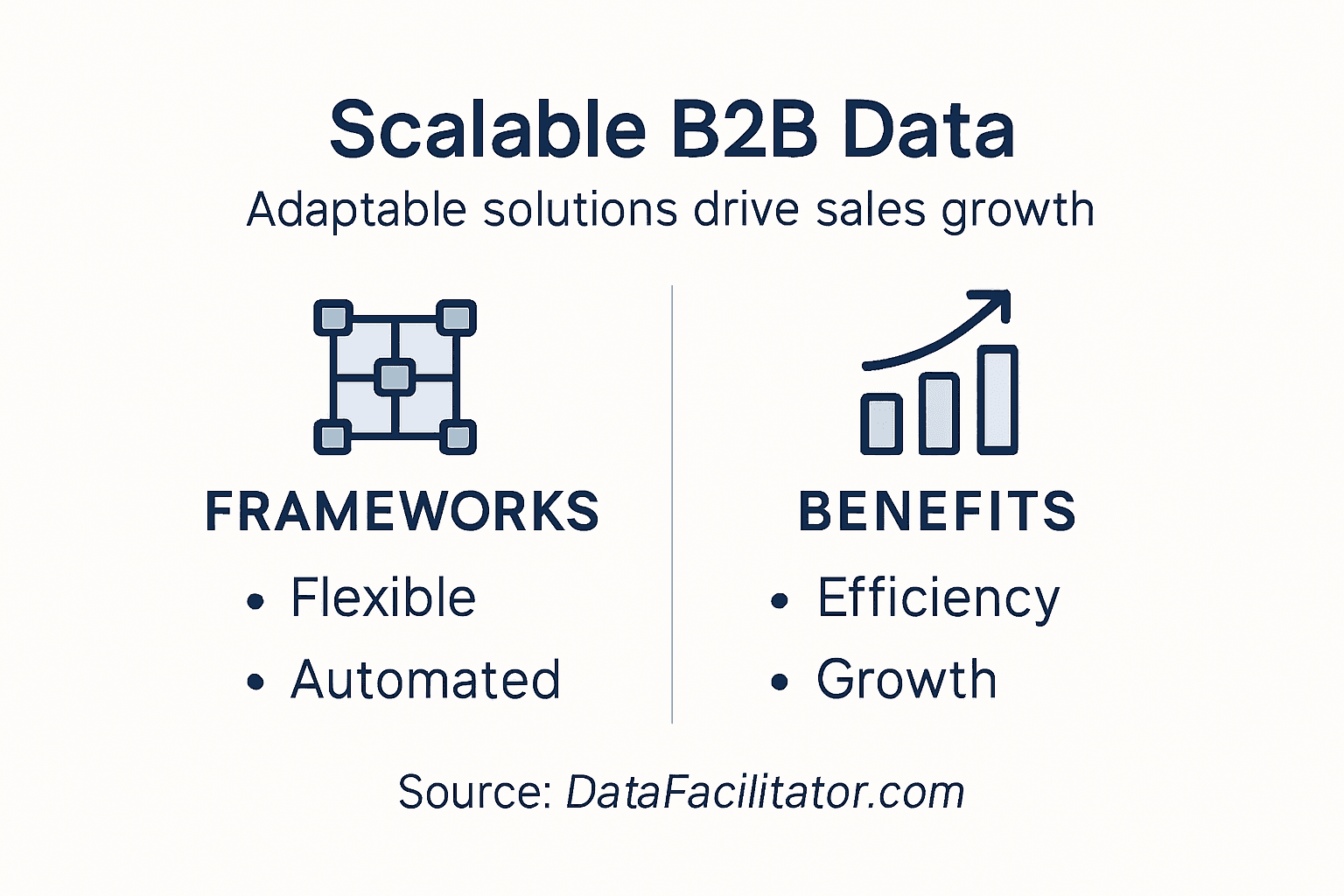
Scalable B2B data solutions represent strategic frameworks designed to handle increasing data volumes efficiently while maintaining performance and accuracy. At their core, these systems enable businesses to expand their data capabilities without compromising quality or operational effectiveness. Scalable technologies embedded within firms’ operations allow organizations to rapidly adapt to changing market demands.
Key Components of scalable B2B data solutions typically include:
- Flexible infrastructure that supports dynamic data growth
- Advanced data processing architectures
- Automated validation and verification mechanisms
- Real-time data synchronization capabilities
- Modular design allowing incremental resource expansion
These solutions are not merely technical configurations but strategic assets that transform how companies manage and leverage information. By implementing scalable systems for handling complex data sets, organizations can significantly enhance their competitive positioning in data-driven markets.
The fundamental goal of scalable B2B data solutions is to create adaptable environments where data volume and complexity can grow seamlessly. This approach ensures that as businesses expand, their data infrastructure evolves proportionally, preventing performance bottlenecks and maintaining high-quality information streams.
Pro tip: Regularly audit and benchmark your data infrastructure to proactively identify potential scalability limitations before they impact business operations.
Key Categories of B2B Company Data
B2B company data represents a multifaceted ecosystem of information critical for strategic business decision-making. Different categories of B2B data provide organizations with comprehensive insights into their market landscape, customer behaviors, and operational dynamics.
Key Categories of B2B company data include:
-
Firmographic Data
- Company size
- Industry classification
- Geographic location
- Annual revenue
- Employee count
-
Transactional Data
- Purchase history
- Contract values
- Product/service interactions
- Payment patterns
- Order frequency
-
Behavioral Data
- Website interactions
- Content engagement
- Digital touchpoint analysis
- Communication preferences
- Decision-making patterns
Understanding these strategic B2B data management approaches allows businesses to create targeted marketing strategies, optimize sales processes, and develop more personalized customer experiences. Each data category offers unique insights that, when combined, provide a holistic view of potential and existing business relationships.
Moreover, sophisticated B2B data management involves not just collecting these categories but integrating them intelligently to drive meaningful business intelligence. By synthesizing firmographic, transactional, and behavioral data, companies can develop nuanced understanding of market dynamics and customer needs.
Here is a comparison of the primary B2B data categories and their unique strategic benefits:
| Data Category | Main Focus | Strategic Benefit |
|---|---|---|
| Firmographic Data | Company attributes | Supports segmentation and targeting |
| Transactional Data | Business activity history | Reveals buying cycles and trends |
| Behavioral Data | Engagement patterns | Enables personalized messaging |
Pro tip: Implement a robust data integration strategy that allows seamless communication between different data categories to maximize insights and operational efficiency.
How Scalable B2B Data Powers Sales
Scalable B2B data has transformed sales strategies by enabling unprecedented levels of precision and efficiency in targeting potential customers. Growth analytics for B2B sales now provide sales teams with powerful insights that dramatically improve their ability to identify, engage, and convert high-potential leads.
Key Sales Enablement Capabilities include:
-
Lead Prioritization
- Intelligent scoring of potential customers
- Predictive likelihood of conversion
- Real-time lead ranking
- Automated qualification processes
-
Strategic Targeting
- Precise demographic matching
- Behavioral pattern recognition
- Industry-specific segmentation
- Customized outreach strategies
-
Performance Optimization
- Detailed sales cycle tracking
- Conversion rate analysis
- Resource allocation insights
- Continuous performance improvement
Scalable technologies for sales operations empower organizations to process extensive customer data rapidly, transforming raw information into actionable strategic intelligence. This approach allows sales teams to adapt quickly, optimize resource allocation, and develop more sophisticated engagement strategies.

Modern B2B sales success increasingly depends on an organization’s ability to leverage data intelligently. By implementing scalable data solutions, companies can create more personalized customer experiences, predict market trends, and develop proactive sales approaches that anticipate customer needs before they are explicitly expressed.
Pro tip: Invest in comprehensive data integration tools that can seamlessly connect multiple data sources to create a holistic view of potential customer landscapes.
Quality, Compliance, and Privacy Standards
B2B data scalability demands rigorous attention to quality, compliance, and privacy standards that protect both organizational interests and individual rights. Data management best practices have emerged as critical frameworks for ensuring responsible data handling in increasingly complex digital ecosystems.
Key Compliance Dimensions include:
-
Data Quality
- Accuracy verification
- Completeness assessment
- Consistency validation
- Timeliness of information
- Error detection mechanisms
-
Regulatory Compliance
- GDPR requirements
- CCPA standards
- Industry-specific regulations
- International data transfer protocols
- Consent management
-
Privacy Protection
- Personal information anonymization
- Data minimization principles
- Access control mechanisms
- Transparent data usage policies
- Individual rights preservation
Successful B2B data strategies recognize that compliance is not merely a legal obligation but a fundamental trust-building mechanism. Organizations must develop robust governance frameworks that balance data utility with ethical considerations, ensuring that scalable data solutions respect individual privacy while delivering actionable business insights.
Moreover, effective data management requires continuous monitoring and adaptive strategies. Companies must invest in sophisticated data governance technologies that can automatically validate, protect, and manage complex B2B datasets across multiple regulatory environments and technological platforms.
Pro tip: Implement regular compliance audits and invest in automated data governance tools that provide real-time monitoring and reporting of potential regulatory risks.
Risks and Mistakes with B2B Data Scalability
Scalable B2B data initiatives are fraught with potential pitfalls that can compromise organizational effectiveness and data integrity. Emerging technology risks demand sophisticated risk management approaches to prevent costly strategic failures.
Common Scalability Risks include:
-
Strategic Misalignment
- Unverified data integration
- Misaligned technology investments
- Inconsistent data governance
- Lack of clear scalability objectives
- Insufficient cross-departmental coordination
-
Security and Compliance Vulnerabilities
- Inadequate data protection protocols
- Regulatory non-compliance risks
- Potential unauthorized data access
- Incomplete audit trails
- Weak authentication mechanisms
-
Operational Performance Challenges
- Infrastructure scalability limitations
- Processing speed degradation
- Resource allocation inefficiencies
- Increased complexity management
- Potential system integration failures
Data sharing risk assessment reveals that organizations must develop comprehensive strategies to mitigate potential data management complications. Proactive risk identification and continuous monitoring are essential for maintaining data ecosystem health and preventing potentially catastrophic operational disruptions.
Successful B2B data scalability requires a holistic approach that balances technological innovation with robust governance frameworks. Companies must invest in adaptive risk management technologies, maintain rigorous compliance standards, and develop organizational cultures that prioritize data integrity and strategic alignment.
The following table summarizes key risks of scalable B2B data initiatives and practical mitigation strategies:
| Risk Area | Major Concern | Mitigation Strategy |
|---|---|---|
| Strategic Misalignment | Technology does not fit goals | Align data roadmap with business strategy |
| Security Vulnerabilities | Potential data breaches | Implement multi-layered protection |
| Operational Performance | System slowdowns | Monitor and optimize continuously |
Pro tip: Conduct quarterly comprehensive risk assessments and maintain a dynamic risk management framework that can quickly adapt to emerging technological and regulatory challenges.
Unlock Scalable B2B Data Solutions That Power Your Sales Growth
Scaling your B2B data infrastructure without sacrificing quality or compliance is a challenge many sales and marketing teams face. The article highlights the critical need for flexible, verified, and real-time scalable data that fuels lead prioritization, strategic targeting, and compliance adherence. If you are struggling with inconsistent or outdated data that hinders your outbound sales and cold outreach success, you are not alone.
At DataFacilitator.com, we deliver highly targeted, scalable B2B contact lists with verified company information tailored to your specific countries, regions, and niches. Our platform embraces transparency by validating data through screen recordings before delivery. This ensures you receive reliable leads to boost your market analysis and sales efficiency without the worry of poor data quality or compliance issues.
Leverage our comprehensive selection available at We handle the leads, you close the deals. – DataFacilitator to transform your sales pipeline.
Experience the power of scalable, compliant B2B data solutions built to support your outbound campaigns and growth objectives now. Visit DataFacilitator.com to explore our data packages designed for results. Don’t let data limitations hold back your sales performance—take action today.
Frequently Asked Questions
What are scalable B2B data solutions?
Scalable B2B data solutions are frameworks designed to efficiently handle increasing data volumes while maintaining performance and accuracy. They enable businesses to expand their data capabilities without compromising quality.
Why is scalability important for B2B data management?
Scalability is crucial as it allows companies to adapt to changing market demands, ensuring that their data infrastructure evolves with business growth. This prevents performance bottlenecks and helps maintain high-quality information streams.
What are the key components of scalable B2B data solutions?
Key components include flexible infrastructure, advanced data processing architectures, automated validation mechanisms, real-time data synchronization, and modular design for incremental resource growth.
How does scalable B2B data impact sales strategies?
Scalable B2B data enhances sales strategies by enabling precise targeting and lead prioritization. It allows sales teams to analyze customer behaviors and optimize outreach efforts, leading to improved conversion rates and more personalized customer experiences.