


Struggling to reach the right decision makers during cold outreach is a familiar roadblock for European SaaS sales teams. The accuracy of your contact lists often determines campaign success, and poor data means wasted effort and compliance risk. B2B data providers play a central role in maintaining reliable supplier information, making it possible to target qualified prospects while protecting your company in complex European markets. This guide explains how data providers help you optimize outreach, maintain compliance, and access well-segmented leads for faster conversions.
Table of Contents
- Defining The Role Of B2B Data Providers
- Types Of B2B Data For Outbound Sales
- Key Data Validation And Delivery Methods
- Legal Compliance And Privacy Standards
- Risks And Common Pitfalls In Data Procurement
- Comparing B2B Data Providers And Alternatives
Key Takeaways
| Point | Details |
|---|---|
| Role of B2B Data Providers | B2B data providers aggregate and verify company information, enhancing sales strategies by ensuring outreach is effective. |
| Types of Data | Key categories include company contact data, company intelligence data, transactional data, and compliance verification data, each serving distinct purposes in sales. |
| Data Validation | Reliable providers employ rigorous validation methods, combining automated checks with human verification to maintain data accuracy. |
| Legal Compliance | Compliance with regulations like GDPR is crucial for purchasing B2B data, and it protects companies from legal repercussions and reputational damage. |
Defining the Role of B2B Data Providers
B2B data providers serve as the connective tissue between your sales team and qualified prospects. Their primary function is straightforward: they aggregate, verify, and organize company information into actionable datasets that salespeople can use for outreach. But the role goes deeper than simply compiling lists of names and email addresses.
When you’re running cold outreach campaigns, you’re essentially playing a numbers game combined with precision targeting. A B2B data provider helps you win at both. They maintain databases of thousands or millions of companies, complete with contact names, direct phone numbers, email addresses, and verified business details. This means your sales development representatives can spend less time hunting for prospects and more time actually engaging them. The quality of this data directly impacts your campaign performance. Poor data leads to bounced emails, wrong contacts, and wasted outreach efforts. Accurate supplier information and relationship quality in B2B environments depend heavily on the data providers who maintain these databases with rigorous verification processes.
For SaaS companies operating across European markets, this becomes even more critical. Your ideal customer profile might be specific: mid-market software companies in Germany with 50 to 200 employees, companies using particular tech stacks, or organizations in specific industries. A quality B2B data provider segments their data precisely enough to help you find these needle-in-the-haystack prospects. They also handle compliance headaches. EU regulations around data privacy and contact information are complex. Providers who operate in compliance with GDPR and local regulations protect your company from legal exposure while you focus on selling.
The role of B2B data providers has also expanded to include data quality maintenance over time. Contacts change jobs. Companies relocate. Email formats shift. A provider that only hands you static data once is less valuable than one who understands that updating your B2B databases regularly improves sales results. They continuously validate information, flag outdated records, and refresh datasets to keep your outreach lists effective across multiple campaigns.
Pro tip: When evaluating B2B data providers, ask specifically about their validation methodology and how frequently they refresh contact information. Providers who can show you screen recordings or detailed audit trails of their data collection process offer transparency you can trust for your outreach campaigns.
Types of B2B Data for Outbound Sales
Not all B2B data is created equal. When you’re planning outbound sales campaigns, you need to understand what types of data actually move the needle on conversions. B2B data providers typically offer several distinct categories, each serving different purposes in your sales funnel.
The foundation is company contact data. This includes verified email addresses, phone numbers, and direct contact names of decision makers at target companies. But beyond basic contact information, providers maintain company intelligence data that tells you about the organization itself: industry classification, company size, revenue range, technology stack, and growth indicators. This contextual information helps you personalize outreach. Instead of sending generic emails, you can reference that a prospect’s company recently raised funding or expanded into a new market. Digital interaction data and customer service insights increasingly inform how B2B data providers help you understand which companies are actively searching for solutions like yours. This data comes from website visits, content consumption, and digital engagement patterns.
Then there’s transactional and usage data. If you’re selling to existing customers or their competitors, understanding what tools they currently use, what they spend, and how they operate gives you massive leverage. Product-service data and customer usage patterns fuel better targeting and more compelling sales conversations. You can tell a prospect exactly how similar companies in their industry are using competitive solutions. For SaaS outreach specifically, data around technology adoption becomes powerful. Are they running legacy systems? Have they invested in cloud infrastructure? Do they use marketing automation? These behavioral and firmographic indicators let you segment prospects into tiers of fit.
Another critical category is compliance and verification data. European B2B data providers maintain records that confirm whether contacts are still at those companies, whether email formats are current, and whether outreach complies with local regulations. This protects your sender reputation and ensures your cold emails actually reach the right people. The best providers layer multiple data sources, so contact information comes verified from recent interactions, not just database entries from six months ago.
Here’s a summary of the main types of B2B data and their business advantages:
| Data Type | Key Characteristics | Business Impact |
|---|---|---|
| Company Contact Data | Direct emails, phone numbers | Enables fast outreach |
| Company Intelligence Data | Industry, size, revenue, tech | Drives tailored messaging |
| Transactional/Usage Data | Purchase behavior, tech stack | Reveals buying patterns |
| Compliance Verification Data | Consent status, recent updates | Protects legal standing |
Pro tip: Request sample datasets from providers that show not just contact names and emails, but the metadata behind them: when was this contact verified, what sources confirmed their role, and how recently was this company information updated. This transparency helps you assess data quality before committing to campaigns.
Key Data Validation and Delivery Methods
Getting data is one thing. Getting data you can actually trust is another. The difference between a mediocre B2B data provider and a reliable one comes down to how rigorously they validate information before it reaches your sales team. Validation is the process that separates outdated contact lists from actionable prospect databases.
Most reputable B2B data providers employ multiple validation layers. The first typically involves automated verification, where software checks that email addresses follow valid formats and haven’t bounced in recent sends. But automation alone misses critical issues. A contact might have left the company three months ago, or a phone number could be for the wrong department. That’s why leading providers add human verification and real-time confirmation. They reach out to companies directly, cross reference information across multiple sources, and maintain centralized feedback systems for reputation management to ensure accuracy over time. Some providers even record their validation process through screen recordings, showing exactly how they confirmed each piece of data. This transparency builds confidence that what you’re paying for is legitimate.

Delivery methods have evolved significantly. Rather than sending you a static CSV file once and calling it done, modern B2B data providers use API integrations and digital platforms that stream verified data directly into your CRM or outreach tools. This approach means you get continuous updates as information changes. If a contact updates their LinkedIn profile or switches companies, quality providers refresh those records in real time. Advanced AI-based validation techniques and multi-platform integration now enable providers to monitor data quality across integrated ecosystems, catching outdated information before it damages your campaign performance. For European SaaS teams, this also means delivery methods that comply with GDPR by design, with clear audit trails showing data sources and consent status.
The payment model matters here too. Providers using a pay-per-result approach have financial incentive to deliver only accurate data. If emails bounce or contacts are unresponsive because data was poor, the provider bears the cost. This aligns their interests with yours. When comparing providers, ask specifically about their validation timeline, what happens if delivered data bounces, and how they handle corrections. The best providers stand behind their data with guarantees.
Pro tip: Before launching campaigns, request a small test batch from any new provider and run it through your email verification tool to check bounce rates. Compare the provider’s claimed accuracy against your actual results, then scale up only if the data meets your performance thresholds.
Legal Compliance and Privacy Standards
If you’re buying B2B contact data in Europe, legal compliance isn’t optional. It’s the foundation that separates legitimate providers from risky ones. The regulatory environment for B2B data has become increasingly strict, and working with non-compliant providers exposes your company to fines, legal action, and reputational damage.
The biggest regulatory framework affecting B2B data procurement is the General Data Protection Regulation (GDPR). Unlike the common misconception that GDPR only applies to consumer data, it covers business contacts too. When you purchase a list of email addresses and phone numbers for German marketing directors, that’s personal data under GDPR’s definition. Your B2B data provider must ensure they’ve collected this information lawfully, with proper consent or legitimate business interest documentation. Beyond GDPR, individual European countries have additional requirements. Germany’s Telemediengesetz, France’s CNIL regulations, and Spain’s LSSI-CE all impose specific rules on how business contact data can be acquired and used. Legal frameworks and privacy standards applicable to B2B platforms vary significantly across regions, requiring providers to maintain transparent data handling and consent management processes. A provider claiming to operate across multiple European countries must demonstrate compliance with each jurisdiction’s specific requirements.
What does this mean practically for your outreach? Reputable B2B data providers document their data sources meticulously. They can show you that contact information came from public business registries, company websites, or direct confirmations from the businesses themselves. They maintain detailed records proving they haven’t purchased data from questionable brokers operating in gray legal areas. When you receive data, you should receive documentation about consent status and data source, not just a spreadsheet. Privacy standards and regulatory requirements for data procurement and sharing directly impact how you can legally use that data in your campaigns. Cold email to business contacts remains legally permissible in most European jurisdictions when done correctly, but the data itself must come from compliant sources.
The safest approach is selecting providers who operate on a pay-per-result model and guarantee compliance. If a contact reports that their data was obtained unlawfully, the provider should have liability insurance and processes to address it. Ask providers directly about their compliance certifications, their legal review processes, and what happens if data is sourced improperly. Don’t assume all low-cost providers are non-compliant, but do verify their compliance framework before purchasing. Your legal team should review the provider’s data handling documentation before you commit to large campaigns.
Pro tip: Request a Data Processing Agreement (DPA) from any B2B data provider you work with. This document clarifies each party’s legal responsibilities under GDPR and confirms the provider has implemented appropriate safeguards for data protection.
Risks and Common Pitfalls in Data Procurement
Buying B2B data sounds simple until something goes wrong. Companies often underestimate the risks involved in data procurement, discovering too late that their investment delivered poor results or worse, exposed them to compliance violations. Understanding common pitfalls helps you avoid expensive mistakes.
The most obvious risk is poor data quality leading to wasted outreach. You buy a list of 5,000 contacts expecting a 2 percent response rate based on the provider’s claims. Instead, you get 15 percent email bounces, outdated job titles, and contacts who never heard of your company’s industry. This happens when providers prioritize volume over accuracy. They’ve collected data from questionable sources, haven’t validated contact information recently, or worse, have used automated scraping without confirming information against actual company records. Your sales team wastes time reaching unqualified prospects while your sender reputation suffers from high bounce rates. Another critical mistake is insufficient data integration with your existing systems. You receive contact data that doesn’t align with your CRM structure, contains duplicate records, or lacks the specific fields you need for segmentation. Poor data integration and insufficient ecosystem coordination in B2B environments create operational friction that prevents sales teams from using the data effectively. What should take an afternoon to import becomes a week of manual cleanup.
Companies also underestimate the importance of ongoing data maintenance. A dataset is fresh on day one and decays from that moment forward. Contacts change jobs. Companies merge. Email formats update. If you’re still using contact data from six months ago without refreshes, your bounce rates climb and your campaigns become less effective. Many procurement pitfalls stem from one-time data purchases rather than relationships with providers who continuously monitor and update information. Additionally, companies sometimes fail to verify compliance status before purchasing. You might buy data that technically violates GDPR or local regulations, exposing your company to legal risk even though you didn’t collect it unlawfully yourself. The provider bears primary liability, but your company still faces reputational damage and potential fines if regulators investigate.
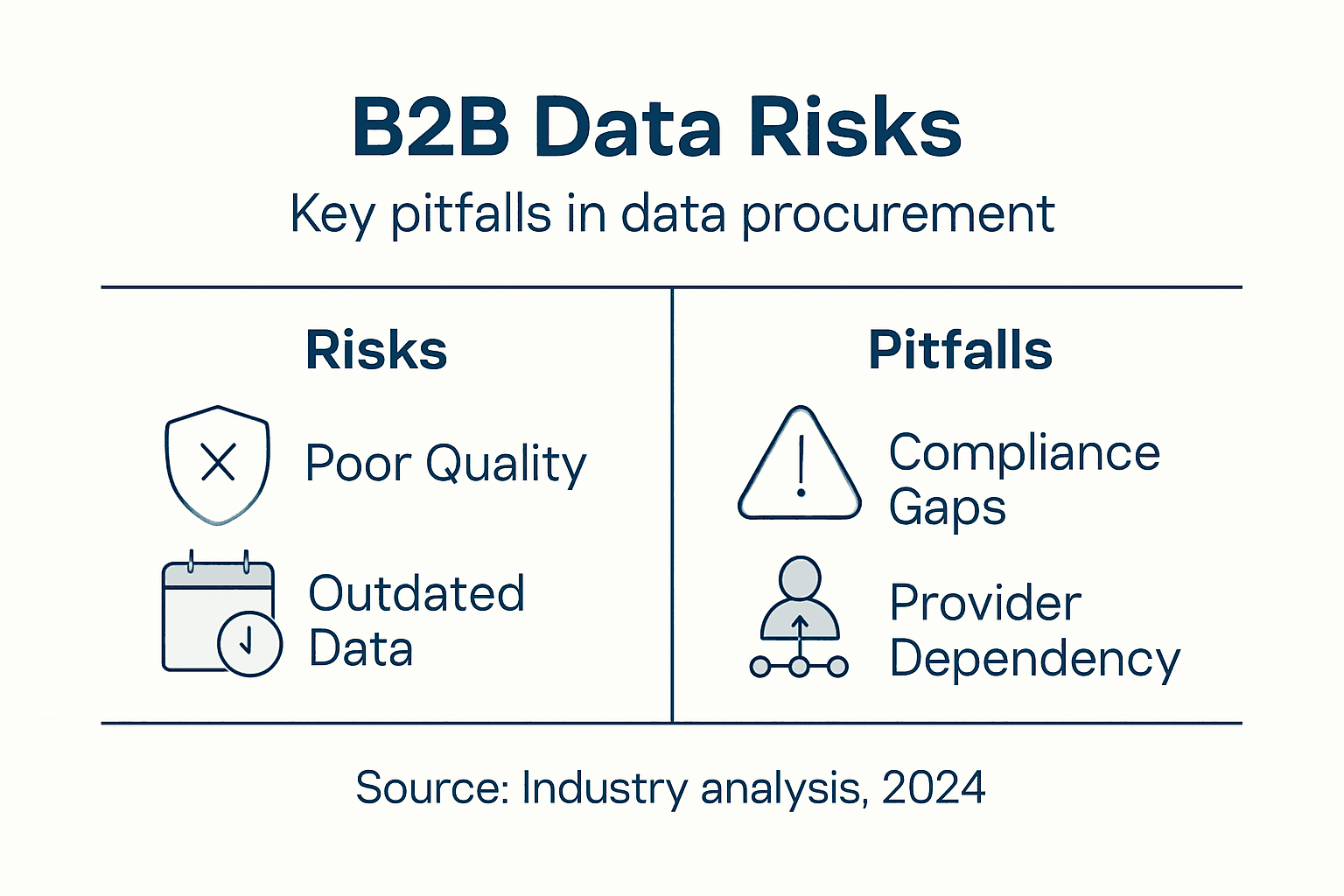
Finally, there’s the risk of provider dependency without alternatives. You build your entire outreach strategy around one provider’s data, then that provider shuts down, raises prices dramatically, or becomes unreliable. Working with smaller regional providers sometimes offers better targeting than global platforms, but diversifying across multiple trusted sources reduces this risk. When evaluating providers, always have a backup plan.
Pro tip: Pilot any new data provider with a small paid test before committing to large campaigns. Measure actual results against their claims: email bounce rates, response rates, and contact accuracy. Only scale spending if real-world performance matches or exceeds their promised metrics.
Comparing B2B Data Providers and Alternatives
You have options when building your prospect database. B2B data providers aren’t your only path to quality contact lists, though they’re often the most efficient one for SaaS teams running active outreach campaigns. Understanding the alternatives helps you make an informed decision about where to invest your resources.
Traditional B2B data providers differ significantly in their business models and data sources. Some focus on breadth, maintaining massive databases across industries and geographies, ideal if you need to reach prospects across multiple markets quickly. Others specialize in depth, covering specific regions or industries with highly verified, niche data. B2B intent data providers vary on multiple criteria including data quality, breadth, and delivery capabilities, making provider selection dependent on your specific needs. A provider excelling at technology company contacts in Germany might be weak in manufacturing prospects in Spain. The pricing model matters too. Some charge per-record, others use monthly subscriptions, and quality providers like DataFacilitator use pay-per-result models where you only pay for leads actually delivered. This alignment of incentives means the provider succeeds only when you succeed.
Beyond traditional providers, you have alternatives. Internal data enrichment leverages your existing customer database and CRM to find lookalike prospects. Tools can scan your best customers, identify common characteristics, and help you find similar companies. This approach is cost-effective if you have a mature customer base, but it limits you to prospects resembling existing customers. You miss entirely new market segments. Third-party integrations and marketplace ecosystems represent another approach. Platforms like LinkedIn Sales Navigator or Apollo use aggregated data from multiple sources, offering breadth but sometimes at the cost of specificity. Different platform types and business models create distinct value propositions for data governance and sales growth. Some provide intent signals showing buying activity, while others focus purely on contact accuracy.
For European SaaS teams, the decision often comes down to compliance and targeting precision. Building contact lists manually by researching company websites takes months and scales poorly. Using scraped data from low-cost providers exposes you to compliance risk. Relying solely on internal enrichment leaves prospects untargeted. The best approach combines focused data provider relationships with internal systems. Use a specialized provider for your primary target market, then layer in internal enrichment for expansion into adjacent segments. Test multiple providers on small campaigns before committing to long-term relationships. The provider delivering your best engagement rates at reasonable cost becomes your foundation.
Compare leading B2B data sourcing strategies by effectiveness and risk:
| Sourcing Approach | Strengths | Weaknesses | Typical Use Case |
|---|---|---|---|
| Specialist Data Provider | High accuracy, legal compliance | Higher cost, limited specialty | GDPR-sensitive SaaS outreach |
| Internal Data Enrichment | Deep customer insight | Narrow focus, slow scale | Leveraging CRM history |
| Marketplace Platforms | Broad reach, easy integration | Generic data, compliance varies | Mass market prospecting |
| Manual List Building | Maximum control, full verification | Very slow, not scalable | Niche segment targeting |
Pro tip: Create a simple test framework comparing providers on three metrics that matter most to your business: actual email bounce rates, response rates from your target audience, and cost per engaged lead. Track these for at least 500 contacts before deciding to scale with any provider.
Unlock Sales Growth with Verified B2B Data You Can Trust
Struggling with inaccurate contact lists and compliance worries can hold back your sales momentum. This article highlights how high-quality B2B data providers empower your outreach with verified and targeted company data tailored for European markets and beyond. At DataFacilitator.com, we go beyond simple datasets by delivering fully validated B2B leads using transparent methods backed by screen recordings. Our pay-per-result model ensures you pay only for real leads that boost your conversion rates, taking the guesswork out of purchasing contact data.
Gain confidence in your campaigns with our customized datasets covering key details such as company size, industry, and technology use. Whether you are expanding into new regions or pursuing hardened cold leads, partnering with us means fewer bounces, fewer compliance risks, and more meaningful conversations. Discover our comprehensive lead packages tailored for targeted outreach by exploring We handle the leads, you close the deals. – DataFacilitator.
Ready to transform your outbound sales strategy with dependable, GDPR-compliant B2B data? Visit DataFacilitator now and see how our scalable solutions fit your unique needs. View all our offerings on We handle the leads, you close the deals. – DataFacilitator to get started immediately and stay ahead in your sales growth journey.
Frequently Asked Questions
What is the primary role of B2B data providers?
B2B data providers aggregate, verify, and organize company information into actionable datasets that help sales teams connect with qualified prospects effectively.
How does quality B2B data impact sales outreach campaigns?
Quality B2B data ensures higher accuracy in contact information, reducing bounced emails and misdirected outreach, which ultimately leads to improved campaign performance and engagement rates.
What types of data do B2B data providers typically offer for sales?
B2B data providers offer various data types, including company contact data, company intelligence data, transactional and usage data, and compliance verification data, each serving distinct functions in the sales process.
How can I verify the quality of data from B2B data providers?
To assess data quality, request sample datasets that show the metadata behind them, such as verification dates and sources, and run small test batches through your email verification tools before fully committing to a provider.