


Most sales teams in the Netherlands overlook a key truth: not all B2B lead sources deliver the same results. When compared to American lead generation tactics, it becomes clear that relying only on cold calls or generic lists can waste resources. For tech marketing professionals, understanding the distinct strengths of each channel opens doors to better compliance and stronger outbound outreach. This guide brings clarity to common misconceptions and pinpoints which lead sources offer the highest conversion potential.
Table of Contents
- Defining B2B Lead Sources And Common Misconceptions
- Types Of B2B Lead Sources In Sales And Marketing
- Key Features Of Reliable Lead Sources
- Legal, Compliance, And Data Quality Standards
- Risks, Costs, And Mistakes To Avoid
Key Takeaways
| Point | Details |
|---|---|
| B2B Lead Sources Are Diverse | Effective lead generation goes beyond cold calling, encompassing digital marketing, referrals, and account-based marketing. |
| Importance of Accurate Data | Reliable lead sources should prioritize data accuracy, currency, and comprehensiveness to enhance conversion quality. |
| Legal Compliance Is Essential | Compliance with international data protection regulations like GDPR is crucial for ethical data handling and privacy. |
| Mitigation of Common Risks | Strategies to avoid misalignment and excessive costs involve clear communication between marketing and sales and a focus on lead quality over quantity. |
Defining B2B Lead Sources and Common Misconceptions
B2B lead sources represent strategic channels through which companies discover and engage potential business customers. Contrary to popular belief, these sources extend far beyond traditional cold calling or generic email campaigns. Modern B2B lead generation involves sophisticated, data-driven approaches that prioritize precision and targeted outreach.
Marketing and sales teams often misunderstand lead sources, treating them as interchangeable or uniform. However, research demonstrates that effective lead sourcing requires nuanced strategies. Machine learning lead scoring models reveal that not all leads are created equal. Some sources consistently produce higher-quality prospects with greater conversion potential, while others generate superficial contacts with minimal business value.
Typical B2B lead sources include multiple strategic channels:
- Direct Referrals: Recommendations from existing clients or professional networks
- Digital Marketing: Targeted content marketing, search engine optimization, and paid advertising
- Industry Events: Conferences, trade shows, and professional networking platforms
- LinkedIn and Professional Social Networks: Targeted connection and engagement strategies
- Account-Based Marketing: Personalized outreach to specific high-value target companies
Pro tip: Always validate lead sources through systematic tracking and conversion rate analysis to continuously optimize your outreach strategy.
Types of B2B Lead Sources In Sales and Marketing
Effective B2B lead sourcing requires a multifaceted approach that leverages diverse channels to connect with potential business customers. Cold lead acquisition strategies have evolved significantly, moving beyond traditional methods to incorporate sophisticated digital and interpersonal techniques.
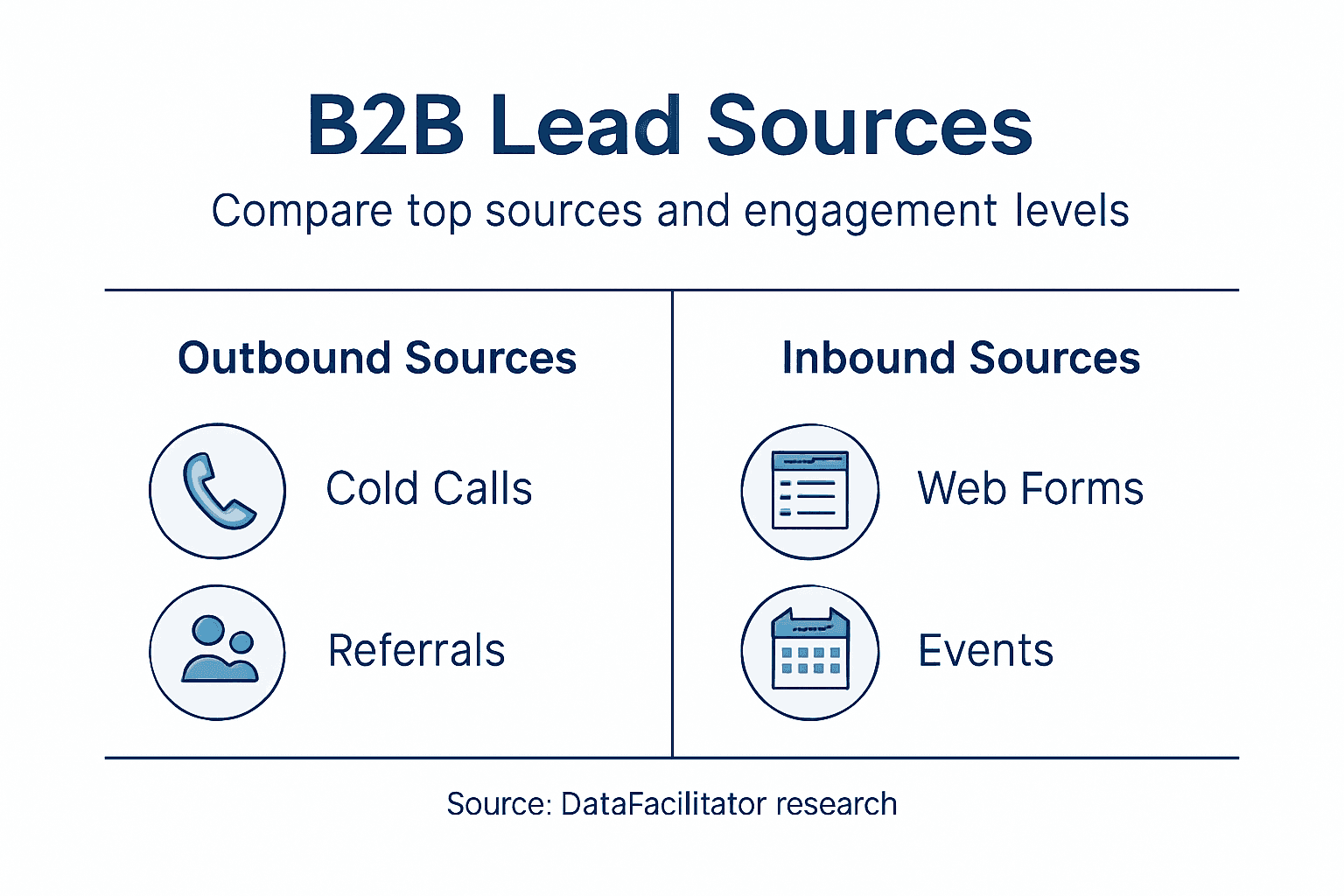
Sales and marketing professionals can leverage multiple strategic lead sources to expand their business network and generate quality prospects. These sources can be categorized into several primary channels:
Inbound Lead Sources:
- Content Marketing: Blogs, whitepapers, and industry reports that attract potential clients
- Search Engine Marketing: Targeted ads and organic search visibility
- Webinars and Online Events: Educational sessions that showcase expertise
- Social Media Engagement: Professional networking platforms like LinkedIn
Outbound Lead Sources:
- Cold Emailing: Targeted, personalized email campaigns
- Direct Sales Outreach: Proactive contact with potential business customers
- Industry Conference Networking: Face-to-face interactions and professional connections
- Referral Programs: Leveraging existing client networks
- Targeted Advertising: Precision digital advertising on professional platforms
Hybrid Lead Sources:
- Account-Based Marketing: Customized approach targeting specific high-value companies
- Partner and Affiliate Networks: Collaborative lead generation strategies
- Professional Databases: Verified contact information from specialized platforms
Pro tip: Implement a comprehensive tracking system to measure conversion rates and quality across different lead sources, allowing continuous optimization of your outreach strategy.
Here’s how inbound, outbound, and hybrid B2B lead sources compare in focus and effectiveness:
| Lead Source Type | Primary Focus | Typical Engagement Level | Conversion Quality |
|---|---|---|---|
| Inbound | Attracting interested prospects | Moderate to high | Strong if well-targeted |
| Outbound | Proactively reaching new contacts | Low to moderate | Variable, depends on targeting |
| Hybrid | Combining personalization with broad reach | High with proper strategy | Highest for targeted accounts |
Key Features of Reliable Lead Sources
Identifying reliable lead sources requires a comprehensive understanding of key characteristics that distinguish high-quality data from generic contact lists. Credible research strategies reveal that exceptional lead sources share several critical attributes that directly impact sales team performance and conversion potential.

The most effective B2B lead sources demonstrate specific hallmark characteristics that ensure data integrity and actionable insights. These fundamental features include:
Data Verification Characteristics:
- Accuracy: Precisely validated contact information
- Currency: Regularly updated and recent data points
- Comprehensiveness: Detailed company and contact profiles
- Source Transparency: Clear documentation of data collection methods
- Compliance: Adherence to international data protection regulations
Quality Assessment Metrics:
- Contact Relevance: Alignment with target industry and role
- Data Depth: Multiple touchpoints and contextual information
- Verification Processes: Rigorous validation and cross-referencing techniques
- Professional Network Validation: Connections through reputable platforms
- Performance Tracking: Measurable conversion and engagement rates
Advanced Sourcing Strategies:
- Machine Learning Validation: Automated data quality checks
- Multi-Source Triangulation: Cross-referencing information from multiple reliable platforms
- Predictive Analytics: Using historical data to assess lead potential
- Continuous Data Refinement: Ongoing quality improvement mechanisms
Pro tip: Implement a systematic scoring mechanism that evaluates lead sources across multiple dimensions, allowing for continuous optimization of your lead generation strategy.
Legal, Compliance, and Data Quality Standards
Navigating the complex landscape of legal and compliance requirements is critical for B2B lead generation strategies. Data protection regulations create a rigorous framework that demands meticulous attention to ethical data handling and privacy protection.
Comprehensive compliance involves multiple layers of legal and operational safeguards:
Legal Compliance Requirements:
- GDPR Adherence: Strict European Union data protection standards
- International Privacy Laws: Compliance with regional data protection regulations
- Explicit Consent Mechanisms: Transparent data collection and usage protocols
- Data Subject Rights: Ensuring individual information access and deletion capabilities
- Cross-Border Data Transfer Regulations: Managing international data transmission
Data Security Protocols:
- Encryption Standards: Advanced protection for stored and transmitted data
- Identity Verification: Robust authentication processes
- Secure Storage Infrastructure: Protected databases with restricted access
- Regular Security Audits: Continuous vulnerability assessments
- Breach Notification Procedures: Transparent reporting mechanisms
Ethical Data Management Practices:
- Anonymization Techniques: Protecting individual identities
- Consent Management Systems: Documented user permissions
- Transparent Data Usage Policies: Clear communication of data handling practices
- Minimal Data Collection: Limiting information gathering to essential requirements
- Ongoing Compliance Training: Ensuring organizational awareness
Pro tip: Develop a comprehensive compliance checklist that maps your data collection processes against multiple international regulatory frameworks, ensuring proactive legal protection.
Risks, Costs, and Mistakes To Avoid
Successful B2B lead generation demands strategic awareness of potential pitfalls that can compromise marketing investments. Common B2B lead generation mistakes often emerge from systemic misalignments and ineffective operational approaches that drain resources and reduce conversion potential.
Companies frequently encounter critical risks that can undermine their lead sourcing efforts:
Strategic Misalignment Risks:
- Marketing-Sales Disconnect: Misaligned goals and communication
- Undefined Target Market: Lack of precise audience segmentation
- Quantity Over Quality: Prioritizing lead volume instead of conversion potential
- Inadequate Lead Scoring: Weak qualification and prioritization mechanisms
- Inconsistent Follow-up Processes: Ineffective lead nurturing strategies
Financial and Resource Risks:
- Wasted Marketing Budget: Inefficient spending on unqualified leads
- High Acquisition Costs: Expensive lead generation without proportional returns
- Technology Investment Errors: Inappropriate tool selection and implementation
- Missed Opportunity Costs: Failing to capitalize on potential high-value prospects
- Prolonged Sales Cycles: Inefficient lead progression and conversion
Operational Performance Risks:
- Weak Data Infrastructure: Unreliable or incomplete lead information
- Ignored Buyer Intent Signals: Missing critical conversion indicators
- Poor Personalization: Generic approaches that fail to engage prospects
- Limited Performance Tracking: Insufficient metrics and analytics
- Reactive Instead of Proactive Strategies: Lacking predictive lead generation methods
Pro tip: Implement a rigorous quarterly review process that critically evaluates lead generation performance, systematically identifying and addressing operational inefficiencies.
Below is a summary of common risks in B2B lead generation and suggested mitigation strategies:
| Risk Area | Example Pitfall | Mitigation Strategy |
|---|---|---|
| Strategic | Marketing-sales misalignment | Establish joint KPIs and regular meetings |
| Financial | Excessive acquisition costs | Prioritize lead quality over quantity |
| Operational | Poor data infrastructure | Invest in reliable data tools and audits |
Maximize Your Sales Outreach with Targeted B2B Leads
Navigating the complex world of B2B lead sources can be overwhelming, especially when trying to overcome challenges such as lead quality, data accuracy, and compliance. This article highlights key pain points like ineffective lead scoring, marketing-sales misalignment, and wasted budget on low-conversion contacts that sales and marketing teams struggle with daily. Leveraging sophisticated lead data that is precise and compliant is critical to transforming cold outreach into measurable results.
Discover how We handle the leads, you close the deals. – DataFacilitator solves these challenges with verified, up-to-date, and segmented contact lists tailored to your industry and region.
Ready to elevate your outbound sales efforts and ensure every lead counts? Visit DataFacilitator.com to explore scalable, pay-per-result B2B datasets that align perfectly with your strategy. Start driving higher conversion rates today with data you can trust and a partner committed to your growth.
Frequently Asked Questions
What are the key B2B lead sources for maximizing sales outreach?
Typical B2B lead sources include direct referrals, digital marketing, industry events, social networks like LinkedIn, and account-based marketing strategies that focus on high-value target companies.
How can I measure the effectiveness of different B2B lead sources?
Implement a comprehensive tracking system that evaluates conversion rates, lead quality, and engagement metrics across different lead sources. This allows for continuous optimization of your outreach strategy.
What are some common misconceptions about B2B lead sources?
Many believe that all lead sources are interchangeable, but research shows that they vary significantly in quality. Successful lead sourcing requires nuanced strategies tailored to specific audience segments.
How do legal and compliance requirements affect B2B lead generation?
Legal compliance, such as adherence to GDPR and international privacy laws, is crucial for ethical data handling in B2B lead generation. Companies must ensure clear consent mechanisms and data protection regulations are followed.