


Every sales team knows the frustration of chasing unqualified leads through generic outreach that never gets a response. For Dutch B2B companies relying on outbound campaigns, finding ways to turn raw contact lists into meaningful, actionable business insights is critical for improving connection rates. This article clarifies what B2B data enrichment really means, breaks down popular misconceptions, and offers proven strategies to help sales and marketing professionals achieve smarter, more successful cold outreach.
Table of Contents
- B2B Data Enrichment Defined and Debunked
- Types and Methods of Data Enrichment
- How Data Enrichment Powers Outreach Success
- Compliance, Data Quality, and Common Pitfalls
- Choosing the Right Enrichment Tools and Partners
Key Takeaways
| Point | Details |
|---|---|
| B2B Data Enrichment | Enhances sales intelligence by augmenting existing datasets with verified information for informed decision-making. |
| Data Accuracy and Compliance | Implement rigorous data quality checks and comply with regulations to ensure reliable and legally sound information usage. |
| Advanced Techniques | Utilize AI and machine learning for continuous data validation, allowing for real-time updates of business intelligence. |
| Vendor Selection | Choose enrichment tools based on data coverage, update frequency, and integration capabilities to align with business goals. |
B2B Data Enrichment Defined and Debunked
B2B data enrichment represents a strategic process of augmenting and improving existing company datasets with additional, verified information to enhance lead quality and sales intelligence. At its core, this practice transforms raw contact information into actionable business insights that empower sales and marketing teams to make more informed decisions.
The fundamental goal of data enrichment goes beyond simple data collection. By integrating multiple data sources, companies can create comprehensive profiles that reveal critical details about potential business prospects, including:
- Company size and revenue
- Technological infrastructure
- Geographic location
- Industry vertical
- Decision-maker contact information
- Recent organizational changes
Data accuracy becomes paramount in this process. Ethical data handling practices require transparent methods of verifying and updating information to ensure reliability. Businesses must distinguish between legitimate enrichment techniques and potentially invasive data gathering strategies.
Effective B2B data enrichment relies on sophisticated techniques that cross-reference multiple reliable sources. This approach helps eliminate outdated or incorrect information while building nuanced company profiles that reflect current market dynamics. The most advanced enrichment strategies leverage artificial intelligence and machine learning algorithms to validate and update datasets continuously.
Pro tip: Implement a quarterly data validation process to ensure your enriched datasets remain current and actionable.
Types and Methods of Data Enrichment
B2B data enrichment encompasses various sophisticated techniques designed to transform raw business information into comprehensive, actionable insights. Data augmentation methods range from synthetic data generation to complex transformation strategies that enhance the depth and quality of existing datasets.
The primary types of data enrichment can be categorized into several key approaches:
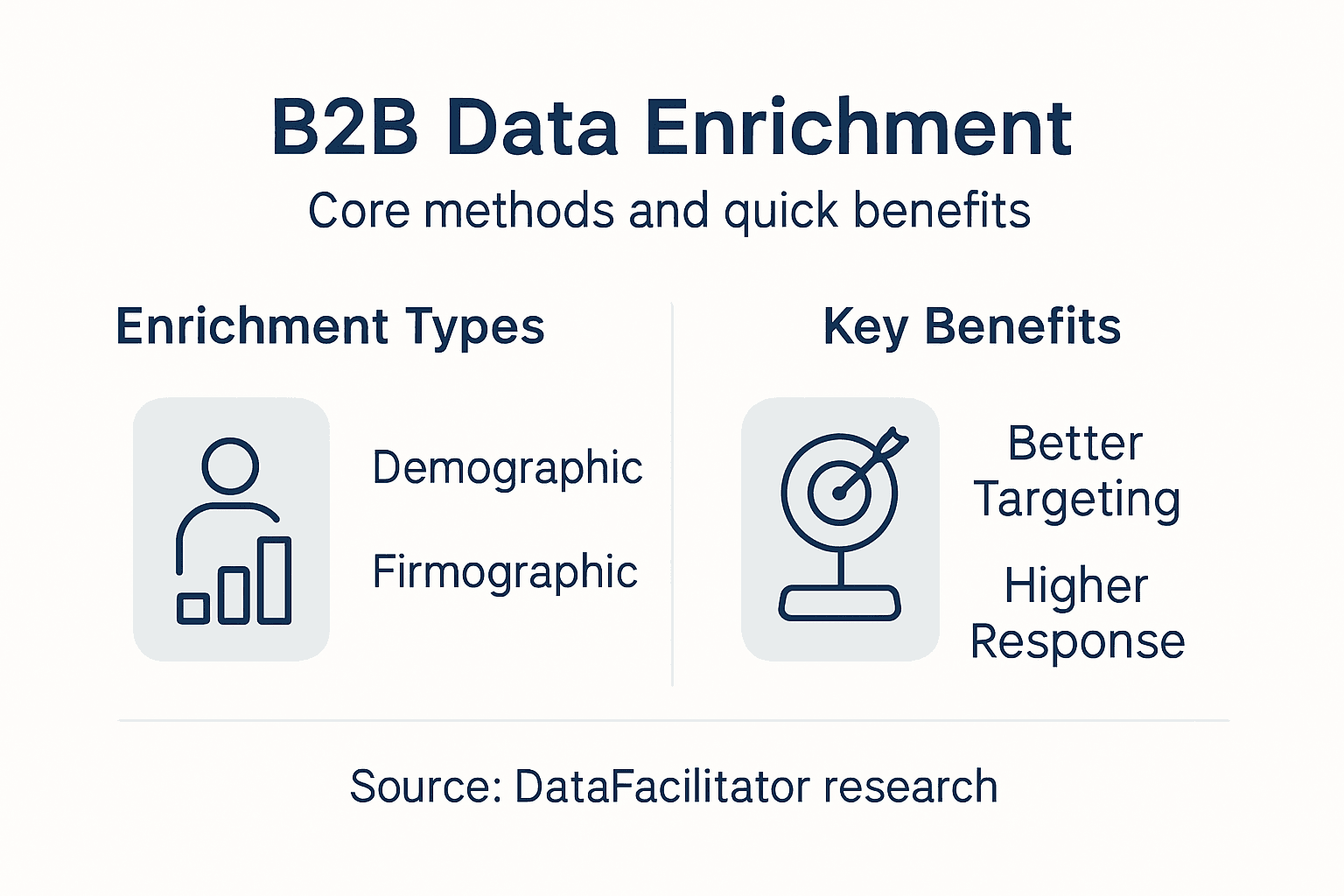
- Demographic Enrichment: Adding detailed demographic information about companies and key decision-makers
- Firmographic Enrichment: Expanding company profile details including industry classification, revenue range, and employee count
- Technographic Enrichment: Identifying and documenting technological infrastructure and software usage
- Contextual Enrichment: Integrating external data sources to provide broader market and competitive insights
Technical approaches to data enrichment involve sophisticated methodologies that go beyond simple data collection. Common data element standardization ensures that disparate data sources can be harmonized effectively, creating more meaningful and integrated business intelligence. These methods typically involve advanced techniques such as machine learning algorithms, natural language processing, and cross-referencing multiple authoritative data sources.
The most advanced data enrichment strategies leverage artificial intelligence to continuously validate and update information. This dynamic approach allows businesses to maintain real-time accuracy, identifying changes in company structures, leadership, and market positioning that traditional static data collection methods might miss.
Here’s a summary of key B2B data enrichment methods and their strategic benefits:
| Enrichment Method | Key Benefit | Ideal Use Case |
|---|---|---|
| Demographic Enrichment | Enables precise targeting | Identifying decision-makers |
| Firmographic Enrichment | Reveals company strengths | Segmenting by size or revenue |
| Technographic Enrichment | Uncovers tech stack details | Tailoring technology solutions |
| Contextual Enrichment | Adds market context insights | Competitive intelligence |
Pro tip: Implement a multi-source validation process to cross-check and verify data enrichment results, ensuring maximum accuracy and reliability.
How Data Enrichment Powers Outreach Success
Data enrichment transforms cold outreach from a hit-or-miss strategy into a precision-driven approach that dramatically improves sales engagement and conversion rates. Integrated data systems enable businesses to create highly targeted outreach campaigns that speak directly to potential customers’ specific needs and challenges.
The key advantages of data-powered outreach include:
- Laser-Focused Targeting: Identifying ideal customer profiles with unprecedented accuracy
- Personalization at Scale: Crafting messages that resonate with specific business contexts
- Predictive Intelligence: Anticipating customer needs before initial contact
- Reduced Waste: Eliminating unqualified leads and focusing resources efficiently
Advanced data enrichment strategies allow sales teams to transform raw contact information into comprehensive prospect profiles. By integrating multiple data sources, businesses can develop nuanced understanding of target markets, uncovering hidden opportunities and potential connection points that traditional outreach methods would miss.

The most successful outreach campaigns leverage enriched data to create a holistic view of potential clients. This approach goes beyond basic demographic information, incorporating technological infrastructure, recent company changes, and predictive behavioral insights that enable more meaningful and timely interactions.
Pro tip: Develop a dynamic scoring system that continuously updates prospect potential based on real-time data enrichment insights.
Compliance, Data Quality, and Common Pitfalls
Navigating the complex landscape of B2B data enrichment requires a rigorous approach to maintaining data quality and regulatory compliance. Quality control measures are critical in preventing data degradation and ensuring the integrity of business intelligence gathered through enrichment processes.
The most significant compliance and data quality challenges include:
- Consent and Privacy Regulations: Ensuring proper data collection and usage permissions
- Data Accuracy: Verifying the reliability of information sources
- Outdated Information: Managing the rapid decay of business contact data
- Duplicate Entries: Preventing redundant and conflicting record management
- Cross-Border Data Restrictions: Navigating international data protection laws
Companies frequently encounter several common pitfalls that can compromise their data enrichment efforts. These include over-relying on a single data source, failing to implement regular data validation processes, and neglecting to establish clear data governance protocols. The consequences of poor data management can be severe, ranging from inaccurate targeting to potential legal complications.
Successful data enrichment demands a proactive approach to data quality. This involves implementing robust verification mechanisms, maintaining transparent data collection practices, and continuously auditing data sources to ensure ongoing reliability and compliance with evolving regulatory standards.
Pro tip: Develop a comprehensive data quality framework that includes quarterly audits and automated validation checks to maintain the highest standards of data integrity.
Choosing the Right Enrichment Tools and Partners
Selecting the most effective data enrichment tools and partners requires a strategic approach that aligns with your organization’s unique business objectives. Learning partnerships provide critical insights into evaluating potential collaborations that can dramatically enhance data quality and outreach capabilities.
Key criteria for selecting data enrichment tools and partners include:
- Data Coverage: Breadth and depth of available information sources
- Update Frequency: How often data is refreshed and validated
- Compliance Certifications: Adherence to international data protection standards
- Integration Capabilities: Seamless connection with existing business systems
- Pricing Model: Transparency and flexibility of cost structures
- Technical Support: Quality and responsiveness of vendor assistance
Successful tool selection demands a comprehensive evaluation process that goes beyond surface-level features. Organizations must conduct thorough due diligence, including detailed technical assessments, reference checks, and pilot testing to ensure the selected solution genuinely meets their specific data enrichment requirements.
For quick reference, here’s how top data enrichment tools can be evaluated:
| Evaluation Criteria | Why It Matters | What to Look For |
|---|---|---|
| Data Coverage | Broadens prospect reach | Diverse industry data sources |
| Update Frequency | Maintains data freshness | Automated, regular refresh cycles |
| Integration Capabilities | Streamlines workflow | Compatibility with CRM platforms |
| Pricing Model | Ensures budget flexibility | Transparent, scalable options |
Advanced data enrichment partners leverage sophisticated technologies like artificial intelligence and machine learning to provide dynamic, continuously updated datasets. These solutions offer more than static information, delivering predictive insights that can transform sales and marketing strategies by providing deeper, more nuanced understanding of potential business opportunities.
Pro tip: Create a comprehensive vendor evaluation matrix that scores potential partners across multiple dimensions, including data quality, compliance, and alignment with your specific business goals.
Unlock Precision and Power in Your Cold Outreach with DataFacilitator
Struggling with outdated leads and generic outreach efforts often means missed opportunities and wasted resources. This article highlights the importance of B2B data enrichment in transforming cold outreach into a strategic, data-driven process. By leveraging enriched, accurate, and up-to-date datasets, you can overcome common pain points like poor targeting and low engagement. DataFacilitator specializes in delivering highly targeted and verified B2B contact lists tailored to your specific industry and region, ensuring your outreach hits the mark every time.
Ready to experience how laser-focused targeting, real-time data validation, and comprehensive company profiles can elevate your sales and marketing efforts? Visit We handle the leads, you close the deals. – DataFacilitator to explore tailored solutions that bring you closer to your prospects. Act now to empower your team with reliable data and start turning cold leads into warm opportunities by visiting https://datafacilitator.com today.
Frequently Asked Questions
What is B2B data enrichment?
B2B data enrichment is a process of enhancing existing company datasets with verified information to improve lead quality and sales intelligence, resulting in actionable business insights.
How does data enrichment improve outreach efforts?
Data enrichment enables businesses to create highly targeted outreach campaigns by providing precise customer profiles, enhancing personalization, and allowing for predictive intelligence that anticipates customer needs.
What are the main types of data enrichment?
The main types of data enrichment include demographic enrichment, firmographic enrichment, technographic enrichment, and contextual enrichment, each providing unique insights about companies and decision-makers.
Why is data accuracy important in data enrichment?
Data accuracy is crucial because it ensures the reliability of the enriched datasets, preventing issues like outdated information or misleading insights that can compromise marketing and sales efforts.